
LIBRARY LITERACY TOUR

LIBRARY LITERACY TOUR (Duration: 1 hour –1.5 hours) 
This module introduces clients, especially new students, to the library’s services, facilities, and learning resources through a guided tour. Participants will gain an overview of the library’s role in supporting academic study and research, become familiar with the physical layout and available study spaces, and learn how to use the library catalogue to locate print and electronic materials. The session also briefly introduces access to digital resources, including databases, e-books, and e-journals, as well as how to obtain research and reference support. By the end of the tour, students should be able to navigate the library independently.
 
What You’ll Learn:
  • Introduction to Library Services and Facilities:
    Overview of the library’s purpose, key services, opening hours, and how the library supports learning and research.
  • Library Layout and Study Spaces:
    Orientation to different zones such as quiet study areas, collaborative spaces, computer facilities, and relaxation areas.
  • Using the Library Catalogue (HikmahPac and EDS):
    How to search for, locate, and access print and electronic resources using the library’s search systems.
  • Accessing Digital Resources and Online Databases:
    Guidance on logging in on- and off-campus, using academic databases, and accessing e-books and e-journals.
  • Research and Reference Support:
    Introduction to help services such as enquiry desks (Readers’ Advisory Desk), research consultations, and subject or liaison librarians.
  • Borrowing, Returning, and Renewing Materials:
    Explanation of loan policies, self-service machines, renewals, and returning items.
  • Study Room and Facility Booking:
    How to reserve study rooms, and other library facilities.
  • Library Policies and User Responsibilities:
    Key rules on behaviour, academic integrity, copyright, and responsible use of resources.
  • Additional Support Services:
    Information on interlibrary loans, accessibility services, and learning support where available.
  • Join us on a journey of discovery and learning. Enrol in our Library Literacy Tour module and open the doors to endless opportunities.
  • Click here to learn more and get started on your path to academic excellence. Your future starts here!

DISCOVERING ACADEMIC RESOURCES WITH THE LIBRARY CATALOGUE & IIUM DISCOVERY SERVICE (Duration: 1 hour – 1.5 hours)
This module equips clients with the skills to effectively search, retrieve, and manage resources using the Library Catalogue (OPAC) and IIUM Discovery Service. Participants will learn how to conduct basic and advanced searches, interpret catalogue records, locate required course materials, and access digital resources such as e-books and journals. The session also covers essential account management functions, including renewals and reservations. By the end of the module, participants should be able to independently identify and access relevant academic materials to support their study and research needs.

What You’ll Learn:

  • Introduction to OPAC and IIUM Discovery Service:
    Purpose of the OPAC, access methods, and an overview of the user interface.
  • Basic Search:
    Searching by keyword, title, author, and subject.
  • Advanced Search:
    Using Boolean operators, filters, truncation, and
    field limits to refine results.
  • Understanding Search Results:
    Interpreting catalogue records,
    including call numbers, item locations, and availability status.
  • Finding Required and Recommended Reading:
    Locating items from course reading lists using the catalogue.
  • Managing Library Account:
    Includes account activation, renewal, reservation of materials, checking of fines, and updating of personal details.
  • Accessing Digital Resources:
    Using the IIUM Discovery Service to access e-books, academic journals, IIUM Theses Repository, and IIUM Institutional Repository (IRep).
  • Join us on a journey of discovery and learning. Enrol in our Discovering Academic Resources with the Library Catalogue & IIUM Discovery Service module and open the doors to endless opportunities.
  • Click here to learn more and get started on your path to academic excellence. Your future starts here!

UNDERSTANDING INFORMATION AND EVALUATING RESOURCES (Duration:1 hour)
This module is geared towards new undergraduate students who are starting to use different types of information for their research and assignments. It introduces understanding information, covering the basic types of information, and guidance on when and how to use each type appropriately in assignments or research projects.
 

What You’ll Learn:

  • Understanding the assignment and finding a research topic.
  • Searching for ideas.
  • Introduction to the information cycle.
  • The types of information: popular and scholarly sources.
  • Brief explanation on peer review.
  • The types of information: primary, secondary, and reference sources.
  • The importance of evaluating information.
  • Basic evaluation of information for research needs.
  • Join us on a journey of discovery and learning. Enrol in our Understanding Information and Evaluating Resources module and open the doors to endless opportunities.
  • Click here to learn more and get started on your path to academic excellence. Your future starts here!

LIBRARY DIGITAL RESOURCES (Duration: 1.5 hour – 2 hours)
This module introduces participants to the library’s key digital resources and their role in supporting academic study, teaching, and research. Participants will learn how to effectively use the library website, IIUM Theses Repository, IIUM Digital Manuscript collections and IIUM Archives to locate reliable academic materials. The session covers essential search strategies, navigation features, and access tools that enable users to retrieve relevant information efficiently. By the end of the module, participants should be able to confidently access, search, evaluate, and use library digital resources to support their academic and research needs.
 

What You’ll Learn:

  • Introduction to Library Digital Resources:
    Overview of the library website, IIUM Theses Repository, IIUM Digital Manuscript collections and IIUM Archives Repository including their purpose and academic value.
  • Using the Library Website Effectively:
    Navigating the website to access the online catalogue, databases, e-journals, e-books, research guides, and library services.
  • Accessing IIUM Digital Theses:
    Searching and using digital theses for research support, understanding thesis structure, and applying proper citation practices.
  • Exploring IIUM Digital Manuscripts:
    Understanding digital manuscripts as primary sources, using metadata and search tools, and applying them in academic research.
  • Search Strategies for Digital Resources:
    Keyword searching, advanced search features, filters, and subject-based browsing for efficient information retrieval.
  • Join us on a journey of discovery and learning. Enrol in our Library Digital Resources module and open the doors to endless opportunities.
  • Click here to learn more and get started on your path to academic excellence. Your future starts here!

EFFECTIVE SEARCHING TECHNIQUES (Duration: 1 hour – 1.5 hours)
This module develops students’ ability to conduct effective literature searches. Participants will learn how to translate research questions into searchable concepts, identify keywords, and apply structured search techniques using Boolean operators, truncation, and advanced filters. The session also focuses on evaluating the quality and relevance of search results, interpreting citations, and managing retrieved sources using library tools or reference managers. By the end of the module, participants should be able to locate credible academic materials more effectively and support their research with reliable evidence.
 

What You’ll Learn:

  • The Research Process in the Library:
    Understanding how to move from a research question to finding, evaluating, and using academic sources.
  • Identifying Keywords and Search Terms:
    Breaking down research
    questions into main concepts, using synonyms, and recognising controlled vocabulary.
  • Search Techniques:
    Using Boolean operators (AND, OR, NOT), truncation, phrase searching, wildcards, nesting, and building effective search strings.
  • Advanced Search Tools:
    Applying filters, limiters, field searching, date ranges, and document types to refine results.
  • Understanding Reading Lists and Citations:
    Interpreting citations and using them to locate required and recommended academic sources.
  • Evaluating Search Results:
    Assessing relevance, credibility, authority, and academic reliability of sources.
  • Saving and Managing Search Results:
    Exporting references, saving searches, and organising sources using library tools or reference managers.
  • Accessing materials not owned by the library:
    Using Interlibrary Loan (ILL) and document delivery services to obtain external resources.
  • Refining and improving search strategies:
    Analysing search outcomes and adjusting keywords, filters, and techniques to improve results.
  • Join us on a journey of discovery and learning. Enrol in our Effective Searching Techniques module and open the doors to endless opportunities.
  • Click here to learn more and get started on your path to academic excellence. Your future starts here!

EFFECTIVE USE OF ACADEMIC DATABASES (Duration: 1.5 hour – 2 hours)
This module provides a training on using major academic databases according to the subject matter of the research, such as Scopus, Web of Science, PubMed, ProQuest Health & Medical Collection, etc. Participants will learn how to perform effective keyword, phrase, and field searches using Boolean operators, filters, and limiters, as well as how to refine and manage search results through sorting, saving, and exporting records. The session also covers other features of the database. By the end of the module, participants should be able to apply search techniques appropriate to the selected database and use its tools to support their works.
 

What You’ll Learn:

  • Introduction to Academic Databases:
    Overview of scholarly databases, their content coverage, and how they differ from search engines and other information sources.
  • Searching in Academic Databases:
    Using keyword, phrase, and field searching, together with Boolean operators, filters, and limiters.
  • Refining and Managing Search Results:
    Sorting results, identifying relevant studies, saving searches, and exporting records.
  • Author and Source Evaluation:
    Exploring author profiles, citation counts, and journal or source quality indicators.
  • Citation Analysis and Research Impact:
    Identifying influential publications and analysing citation patterns to assess research impact.
  • Research Trends and Collaboration:
    Exploring topic development, co-authorship patterns, and research collaboration.
  • Alerts and Research Monitoring:
    Setting up alerts to track new publications, citations, and updates on specific authors or topics.
  • Using Databases with Reference Management Tools:
    Exporting records to reference managers (e.g. Mendeley, EndNote, Zotero) and using data for further analysis.
  • Join us on a journey of discovery and learning. Enrol in our Effective Use of Academic Databases module and open the doors to endless opportunities.
  • Click here to learn more and get started on your path to academic excellence. Your future starts here!

EFFECTIVE SEARCHING FOR ISLAMIC, ARABIC OR MALAY INFORMATION RESOURCES (Duration: 1.5 hour – 2 hours)
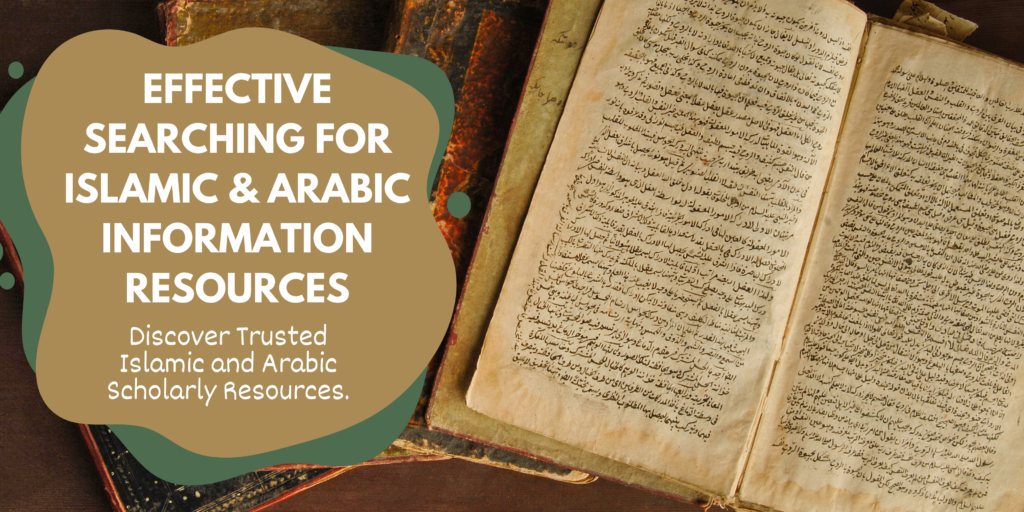
This module introduces students to specialised cultural and language-based information resources, with a focus on Islamic, Arabic, and Malay materials. Participants will learn about the nature of primary and secondary sources, their key characteristics, and the linguistic and textual features that influence how such resources are created, organised, and accessed. By the end of the module, participants should be able to navigate and critically use cultural and regional resources more effectively for academic study and research.
 

What You’ll Learn:

  • Foundations of the resources:
    Overview of primary and secondary sources related Islam, Arabic, or Malay studies.
  • Characteristics of the resources:
    Key features of cultural and language based resources, such as subject scope, authorship, formats, and publication contexts.
  • Textual and linguistic features:
    Understanding language structures, terminology, script variations, and historical language usage in specialised
    resources.
  • Search Strategies:
    Using appropriate keywords, subject terms, and language variations to locate relevant materials.
  • Navigating specialised information platforms:
    Using library catalogues, databases, archives, and digital repositories that hold cultural and regional
    materials.
  • Using subject and functional terms:
    Applying thematic, legal, religious, or cultural terms to improve search accuracy and relevance.
  • Language variations and transliteration:
    Recognising spelling variations, transliteration systems, and historical language forms in
    specialised resources.
  • Evaluating the sources:
    Assessing authority, authenticity, reliability, and academic value of specialised materials.
  • Join us on a journey of discovery and learning. Enrol in our Effective Searching for Islamic, Arabic or Malay Information Resources module and open the doors to endless opportunities.
  • Click here to learn more and get started on your path to academic excellence. Your future starts here!
 

USING AI FOR LEARNING AND RESEARCH (Duration: 1.5 hour – 2 hours)
This module explores how artificial intelligence (AI) tools can be used to support academic information searching, learning, and research while maintaining critical judgement and academic integrity. The session also focuses on writing effective prompts, evaluating the accuracy and limitations of AIgenerated content, and understanding issues related to bias, misinformation, plagiarism, and data privacy. By the end of the module, participants should be able to use AI tools such as Gemini AI, NoteBookLM, ChatGPT, etc. responsibly, critically, and ethically as part of their academic and research workflow.
 

What You’ll Learn:

  • Challenges in academic information searching:
    Common difficulties in finding, filtering, and evaluating reliable academic information.
  • Role of AI in learning and research:
    How AI tools can support information discovery, study skills, and research processes.
  • Writing effective prompts for academic tasks:
    Principles of prompt design to obtain accurate, relevant, and useful responses from AI tools.
  • Using AI for information searching:
    Step-by-step guidance on using AI tools to generate search strategies, keywords, and research ideas.
  • Evaluating AI-generated information:
    Assessing accuracy, credibility, bias, including misinformation risks and lack of source transparency.
  • Ethical use of AI in academic work:
    Issues of academic integrity, plagiarism, data privacy, and responsible AI use.
  • Limitations of AI for research:
    Understanding limitations of AI such as hallucination, information coverage etc.
  • Join us on a journey of discovery and learning. Enrol in our Using AI for Learning and Research module and open the doors to endless opportunities.
  • Click here to learn more and get started on your path to academic excellence. Your future starts here!

CITING AND REFERENCING (Duration: 1.5 hour – 2 hours)
This module introduces students to citation and referencing, covering the importance of citing sources, when to cite, and an overview of common citation styles. The session also provides guidance on managing references, including copying citations from databases or tools like Mendeley, Zotero, Bibtext, and offers a brief introduction to reference management tools. By the end of the module, participants should be able to cite sources accurately and properly integrate references in their writing. Clients may choose between a focus on APA 7th edition, Chicago 18th edition, or AIKOL Citation Referencing Style (Ahmad Ibrahim Kulliyyah of Laws Citation Referencing Style). This session does not provide instruction on using specific reference management tools such as Mendeley Reference Manager.
 

What You’ll Learn:

  • Introduction to academic referencing:
    Purpose of referencing, academic
    integrity, and avoiding plagiarism.
  • Why citation matters in academic writing:
    Giving credit to sources, supporting arguments, and demonstrating research credibility.
  • Overview of common citation styles:
    Introduction to major styles such as APA, Chicago, Harvard, MLA, and others, and when they are used.
  • In-text Citations:
    How to cite sources within the text using different citation styles.
  • Reference Lists and Bibliographies:
    Formatting reference lists and bibliographies according to various citation styles.
  • Citing Different Types of Sources:
    Books, journal articles, websites, reports, conference papers, and multimedia sources.
  • Quoting, paraphrasing, and summarising:
    Integrating sources ethically and effectively into academic writing.
  • Common reference errors:
    Typical mistakes in citation and how to avoid them.
  • Using Reference Management Tools:
    Introduction to tools such as EndNote, Mendeley, or Zotero to manage references.
  • Join us on a journey of discovery and learning. Enrol in our Citing and Referencing module and open the doors to endless opportunities.
  • Click here to learn more and get started on your path to academic excellence. Your future starts here!
 

REFERENCE MANAGEMENT TOOLS (Duration: 1.5 hour – 2 hours)
This module introduces reference management tools such as Mendeley, Zotero, EndNote, etc. as essential supports for organising, reading, citing, and collaborating in academic research. Participants will learn how to set up and manage user accounts, build and organise personal reference libraries, and import sources from databases, PDFs, and manual entries. The session also covers annotating full-text documents, generating in-text citations and bibliographies in different citation styles, and sharing references through collaborative features. By the end of the module, participants should be able to use reference management tools to support a more organised, accurate, and productive research process.
 

What You’ll Learn:

  • Introduction to reference management tools:
    Overview of common reference management tools, their key features, and how they support academic research.
  • Creating and managing user accounts:
    Setting up accounts, syncing across devices, and accessing cloud-based libraries.
  • Building and organising a reference library:
    Importing references from databases, PDFs, and manual entry; organising sources using folders, tags, or collections.
  • Annotating and managing full-text documents:
    Highlighting,
    commenting, and adding notes to PDFs to support effective reading and literature review.
  • Generating citations and bibliographies:
    Inserting in-text citations, creating reference lists, and switching between citation styles (e.g. APA, Harvard, Chicago).
  • Collaborating with others:
    Sharing references and notes through group libraries or shared folders.
  • Syncing, Backup, and Data Management:
    Managing cloud
    synchronisation, storage, and offline access to references.
  • Best Practices for Reference Management:
    Maintaining accurate records, updating citation styles, and linking tools with academic databases and researcher profiles.
  • Join us on a journey of discovery and learning. Enrol in our Reference Management Tools module and open the doors to endless opportunities.
  • Click here to learn more and get started on your path to academic excellence. Your future starts here!

CONDUCTING SYSTEMATIC LITERATURE REVIEWS (Duration: 1.5 hour – 2 hours)
This module provides structured training on conducting systematic literature reviews (SLRs) in accordance with PRISMA guidelines. Participants will learn how to formulate clear, focused research questions using established frameworks such as:
     i. PICO: Population, Intervention, Comparison, Outcome.
     ii. SPIDER: Sample, Phenomenon of Interest, Design, Evaluation, Research type.
     iii. SPICE: Setting, Perspective, Intervention, Comparison, Evaluation.
     iv. PICoS: Population, Phenomenon of Interest, Context, Study design.
 
Also learn on how to define transparent inclusion and exclusion criteria. The session covers the development of comprehensive search strategies using Boolean logic, controlled vocabulary, and advanced search techniques, as well as the selection of appropriate databases and information sources. Students will also learn how to document searches, manage results, remove duplicates, screen studies systematically, and record the study selection process using PRISMA flow diagrams. By the end of the module, participants should be able to conduct and document a PRISMA-compliant literature search for systematic reviews.
 

What You’ll Learn:

  • Introduction to Systematic Literature Reviews (SLRs):
    Purpose of SLRs and how they differ from narrative or general literature reviews.
  • Overview of PRISMA Guidelines:
    What PRISMA is, why it matters, and how it ensures transparency and reproducibility.
  • Formulating a Structured Research Question:
    Using frameworks such as PICO, SPIDER, SPICE, or PICoS to define scope and eligibility.
  • Defining Inclusion and Exclusion Criteria:
    Setting clear criteria for study selection (population, time range, language, study type, etc.).
  • Identifying Search Concepts and Terms:
    Translating the research
    question into key concepts, keywords, synonyms, and controlled vocabulary.
  • Building a Comprehensive Search Strategy (search string):
    Using Boolean operators, truncation, phrase searching, nesting, and field searching.
  • Selecting Databases and Information Sources:
    Choosing
    appropriate bibliographic databases and supplementary sources based on subject coverage.
  • Executing and Documenting the Search:
    Recording search strings,
    databases searched, dates, and filters applied (PRISMA compliant documentation).
  • Managing Search Results:
    Exporting records, removing duplicates, and organising results using reference management tools.
  • Screening Studies Systematically:
    Title/abstract screening and fulltext screening using predefined eligibility criteria.
  • Recording the Study Selection Process:
    Documenting numbers of records identified, screened, excluded, and included (PRISMA flow diagram).
  • Assessing Search Completeness:
    Checking for missing studies and
    refining strategies if necessary.
  • Reporting the Search Methods:
    Writing a transparent, reproducible search methodology section.
  • Join us on a journey of discovery and learning. Enrol in our Conducting Systematic Literature Reviews module and open the doors to endless opportunities.
  • Click here to learn more and get started on your path to academic excellence. Your future starts here!

BASIC FORMATTING ACADEMIC WORK IN MICROSOFT WORD (Duration: 1.5 hour – 2 hours)

This module introduces students to the principles and practices of academic formatting to ensure clarity, consistency, and compliance with institutional requirements. Participants will learn how to set up documents correctly, apply appropriate font and paragraph formatting, use heading styles for structured writing, and format page numbers, headers, footers, and title pages. The session also covers the proper presentation of tables, figures, captions, and reference lists, as well as the creation of automatic tables of contents using built-in styles. By the end of the module, participants should be able to produce professionally formatted academic documents that meet formal submission standards.
 

What You’ll Learn:

  • Introduction to Academic Formatting:
    Why formatting matters in academic work readability, professionalism, and meeting institutional requirements.
  • Document Setup:
    Page size, margins, orientation, and line spacing for academic assignments.
  • Font and Text Formatting:
    Choosing appropriate fonts, font size, paragraph spacing, alignment, and indentation.
  • Using Styles for Consistent Formatting:
    Applying heading styles for sections and subsections to ensure uniform structure.
  • Page Numbers and Headers/Footers:
    Inserting and formatting page numbers, headers, and footers correctly.
  • Cover Pages and Title Pages:
    Creating a properly formatted title page for assignments or reports.
  • Paragraph and Section Formatting:
    Managing spacing between paragraphs, section breaks, and alignment.
  • Inserting Tables, Figures, and Captions:
    Formatting tables and images with captions and numbering.
  • Creating Automatic Tables of Contents:
    Using heading styles to generate and update a Table of Contents.
  • Referencing and Citation Formatting:
    Formatting in-text citations and reference lists consistently.
  • Using Templates and Presets:
    Applying and modifying Word templates for academic use.
  • Final Checks and Formatting Consistency:
    Reviewing formatting, fixing layout issues, and preparing the final submission.
  • Join us on a journey of discovery and learning. Enrol in our Basic Formatting Academic Work in Microsoft Word module and open the doors to endless opportunities.
  • Click here to learn more and get started on your path to academic excellence. Your future starts here!

LEGAL RESEARCH SKILL (Duration: 1.5 hour – 2 hours)

This module introduces students to the organisation, citation practices, and retrieval of legal information resources for academic and professional research. Participants will learn about the types and arrangement of legal materials in the library, including statutes, acts, law reports, journals, and monographs. By the end of the module, participants should be able to identify, access, and use legal resources effectively for coursework and research purposes.
 

What You’ll Learn:

  • Types and arrangement of legal resources in the library (Statutes, acts, reprints, law journals, law monographs, etc.).
  • Understanding citations and searching for materials.
  • How to retrieve legal primary & secondary resources: Acts, law reports, law books & law journals.
  • Online Databases for law materials.
  • Online information resources for legal research.
  • Join us on a journey of discovery and learning. Enrol in our Legal Research Skill module and open the doors to endless opportunities.
  • Click here to learn more and get started on your path to academic excellence. Your future starts here!

Information Literacy Classes

Workshops and Seminars

Expert Liaison Librarians

Academic Guidance

Exhibitions and Talks

Access to Resources

Official Address
International Islamic University Malaysia (IIUM)
P.O. Box 10, 50728
Kuala Lumpur, Malaysia
Phone : +603 6421 6421
Fax : +603 6421 4053
Email : webmaster@iium.edu.my

Dar al-Hikmah Library

International Islamic University Malaysia (IIUM)
P.O Box 10, 50728
Kuala Lumpur, Malaysia
Phone:

❭ +603-6421 4825 (Circulation Counter)
❭ +603-6421 4815 (Readers Advisory Desk)
Fax : 03-6421 4855
Email: library@iium.edu.my
*** For Library Clearance Application, please
CLICK HERE
Hide Footer Theme Credit
Your Website

Copyright © 2026 Dar al-Hikmah Library, IIUM. All rights reserved.